
Quizience is supported by you the audience. When you purchase through links on our site, we may earn an affiliate commission.
If you’re looking for the best projectors overall, there are numerous options available, ranging from budget-friendly, portable models to high-end home theater setups. Are you specifically seeking a projector for home theater use? Do you want a versatile device that handles both the latest movies and gaming sessions with ease? Or are you looking for something that’s easy to carry around? Whatever your needs, we’ve got you covered, from more affordable models that trade image quality for portability to bulkier, pricier units that deliver top-notch image quality. Many portable projectors also come with smart features, eliminating the need for an external streaming device. However, larger models may require an external streaming dongle for smart functionality. Ultimately, the best choice depends on your specific needs and budget. If you’re unsure how far you can place a given projector for your screen size, our projector throw distance tool can help you plan your setup.
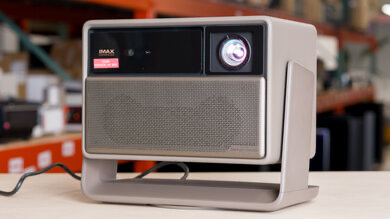
Best Projector: XGIMI HORIZON 20 Max
If you want a single box that does almost everything well, pick the XGIMI HORIZON 20 Max, as it’s the best projector that we’ve tested. It’s the brightest projector we’ve measured, so it holds its punch in living rooms with lamps on and looks even better once the lights go down. Even with its high brightness, the picture stays polished, with crisp 4k (via pixel shift), a wide color gamut, and excellent contrast. Out of the box, it’s impressively accurate, and XGIMI’s fast autofocus, auto-keystone correction, and intelligent screen alignment make setup feel instantaneous; drop it on a coffee table and you’re dialed in within seconds.
Gamers aren’t left out either. In Game Mode, input lag is low enough that 4k @ 60Hz story games feel responsive, and 1080p @ 120Hz or 1080p @ 240Hz is snappy enough for faster titles. It also supports VRR, which helps reduce tearing and smooth out small frame-rate dips, although you can see some artifacting in games with very unstable FPS, so it works best when your frame rate is capped or relatively steady. The smart platform covers the basics of big apps, including Chromecast built-in, Wi-Fi, and Bluetooth, making streaming straightforward. For most people, this is the all-around winner. Still, if you do not need this much brightness, the XGIMI HORIZON 20 Pro delivers a very similar overall experience for less money, just with lower peak light output.
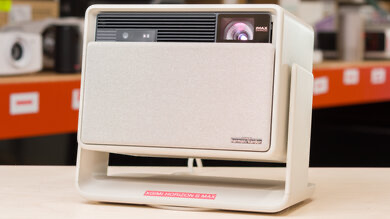
Best Mid-Range Projector: XGIMI Horizon S Max
If you want a mid-range projector that feels like a step up from the cheaper picks without jumping to flagship pricing, go with the XGIMI HORIZON S Max. It uses a Dual Light 2.0 tri-laser plus LED engine with 4k pixel shifting, and it puts up a sharp, clean picture with strong color right out of the box. It gets bright enough for a living room with a few lights on, and its contrast is solid enough that movies still look punchy once you dim the room. Setup is also nearly effortless thanks to ISA 5.0, a rotating stand, and a sliding lens cover, so it is easy to drop it on a table and get a straight image fast.
For gaming, think of it as a very good 60Hz option. With Game Mode and Ultra Low Latency enabled, input lag is low enough that console and single-player games feel responsive, and the image stays bright and colorful while you play. The catch is that there is no 120Hz mode, so if high frame rate gaming is the priority, you might want to step up to the XGIMI HORIZON 20 Max. For the home theater crowd, it has eARC on its lone HDMI port, but that means you cannot use it to pass through audio from other HDMI sources, so external players and consoles will need to send audio directly to your sound system, unlike the 20 Max above. Still, as a balanced mid-range pick with strong picture quality and a very easy day-to-day experience, the S Max is a great all-purpose choice.
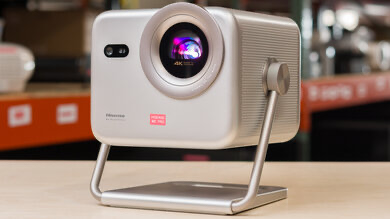
Best Budget Projector: Hisense M2 Pro
If the XGIMI Horizon S Max is too expensive for you, or you’re looking for more gaming features, check out the Hisense M2 Pro. It’s a compact triple-laser model that delivers a crisp pixel-shifted 4k image, plus a very wide color gamut that makes content look rich and saturated. It isn’t bright enough to be used in rooms with lights, but it’s bright enough for evening viewing with a lamp on in the background, and its native contrast is strong, so darker scenes keep their depth instead of looking totally flat. It’s also a better gaming option than most budget projectors. Input lag is good across the board for comfortable console play, and it feels especially snappy at 1080p @ 240Hz, making it a fun big-screen option for fast PC games.
Where it really earns the budget crown is convenience. It has a built-in VIDAA smart platform with Netflix support, casting, and a solid auto-setup suite (autofocus, auto keystone, screen fit, and obstacle avoidance), so it feels like a complete living-room projector without needing a dongle. Connectivity is modern too, with HDMI (including eARC for a soundbar, but like the S Max it can’t passthrough audio from another device) plus USB, and its built-in speaker system is usable in a pinch. Overall, it’s the easiest budget-friendly way to get a sharp, colorful big-screen image with modern smart features and genuinely good gaming responsiveness.
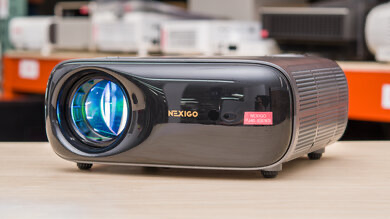
Best Cheap Projector: NexiGo PJ40 (Gen 3)
If the picks above are too expensive for you, or if you just want a small and cheap projector with excellent contrast, the NexiGo PJ40 (Gen 3) is the smart pick. It’s the least expensive model on our list yet punches above its weight with solid native contrast that holds up well in a dark room. Where you lose out is in brightness; it’s respectable for its class, but it won’t compete with daylight or a lot of lamps, and colors can look a bit subdued until you adjust them. Out of the box, accuracy isn’t great; budget a few minutes to dial in a Movie/Cinema preset or run a quick calibration, though most people likely won’t care if some of its colors deviate from the reference.
For the money, you get a ton of useful features: Bluetooth 5.1 and Wi-Fi with casting (Miracast and Apple AirPlay), plus two HDMI inputs, one with ARC for a soundbar, and a 20W speaker system that’s fine for casual viewing. The built-in Android TV is basic and can feel sluggish, so a Chromecast or Fire TV Stick is a better streaming solution. There’s a Game Mode, but treat it as a nice-to-have rather than a performance game-changer, as the unit’s input lag is too high for most games. Still, on a modest screen after dark, the 1080p PJ40 (Gen 3) delivers genuinely good value for the lowest possible price.
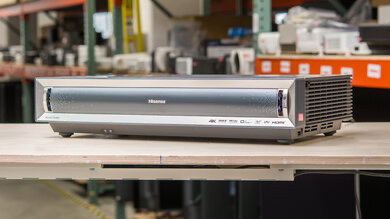
Best Ultra-Short-Throw Projector: Hisense PX3-PRO
If you want a true TV replacement that lives inches from the wall, the ultra-short-throw (UST) Hisense PX3-PRO is the step to take. Its TriChroma RGB-laser light engine delivers vivid color and plenty of punch for evening viewing. Setup is simple: place it on a low cabinet, pull a 100- to 120-inch image (up to 150 inches), and you never worry about people casting shadows or walking through the beam. Google TV handles apps smoothly, and sound is perfectly fine for casual nights; eARC is there when you’re ready for a soundbar. Gamers get a Game Mode with 4k @ 60Hz and up to 1080p @ 240Hz support, so consoles feel responsive without sacrificing sharpness. Still, it’s noticeably slower than the similarly priced XGIMI HORIZON 20 Max for gaming, but still satisfactory, especially at higher refresh rates.
Sound is competent for casual use, and eARC lets you hand off audio to a soundbar or AVR when you want more impact. For the best daytime results, pair it with a UST ALR screen; placement is simple on a low stand against the wall, and you’ll get a flatter, brighter image than projecting onto paint. Overall, if you’re shopping for USTs, the PX3-PRO’s combination of color volume, modern smart TV OS, and decent gaming chops puts it at the top of the list.
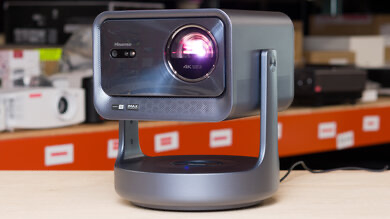
Best Gaming Projector: Hisense C2 Ultra
If you want the best gaming projector, go with the Hisense C2 Ultra. It’s a short-throw 4k (pixel-shifted) laser projector that looks genuinely sharp on a big screen, and it has the image quality to match its gaming chops. Brightness is strong enough for a living room with a couple of lights on, contrast is great, and the color gamut is extremely wide, so games look rich and saturated. Out of the box, it’s already quite accurate, and it cleans up nicely with calibration if you are picky.
For gaming, it’s a standout because it stays responsive across the modes people actually use. Input lag at 4k @ 60Hz is comfortably low for consoles, and it also supports 1080p @ 120Hz and 1080p @ 240Hz for smoother, faster PC play. It accepts a 1440p signal, as well as 4k @ 120Hz, but it downscales them to 1080p, so it’s best to think of it as a 4k60 console projector with high refresh 1080p support. VIDAA smart features are built in with official Netflix, its 2.1-channel 40W JBL speakers are solid in a pinch, and eARC makes it easy to add a soundbar or AVR. Setup is painless thanks to the rotating gimbal stand, plus autofocus, auto-keystone, and obstacle avoidance. Overall, it’s the most complete gaming projector option, combining low-lag play with standout brightness, color, and short-throw-friendly setup flexibility.
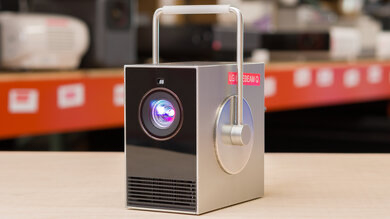
Best Portable Projector: LG CineBeam Q
If you’re searching for a truly portable projector, consider the LG CineBeam Q. Its ultra-compact, design-first chassis is easy to slip into a bag, and setup stays hassle-free thanks to fast autofocus and keystone tools. There’s no built-in battery, but it can run from a USB-C Power Delivery (65W or higher) source, so a compatible power bank works well for picnics and patios without an outlet. LG’s webOS offers big-app support, including Netflix, and provides convenient casting via AirPlay/Screen Share, along with Wi-Fi and Bluetooth for seamless connections.
Despite its tiny size, the LG’s RGB-laser light source produces a crisp 4k (via pixel-shift) image with rich color. While the built-in speaker is perfectly fine for a quick watch in a small room, you’ll get a much bigger, cleaner soundstage by pairing a Bluetooth speaker. Like most ultra-portables, it isn’t bright enough for well-lit rooms; however, it shines after dark and on modest screen sizes due to its truly excellent contrast. In short, the CineBeam Q nails the balance of true carry-everywhere portability with an easy smart-TV experience, making it the best portable projector.